AI Day · September 2026 · 6 min read
A day at Google, and five things I keep coming back to
Google AI Day for Startups, at Google Ananta in Bengaluru. Cost, security, what actually ships, how much one founder can now do, and the gap none of it closes on its own.

Harshit Gupta
Co-founder, evvolv.ai
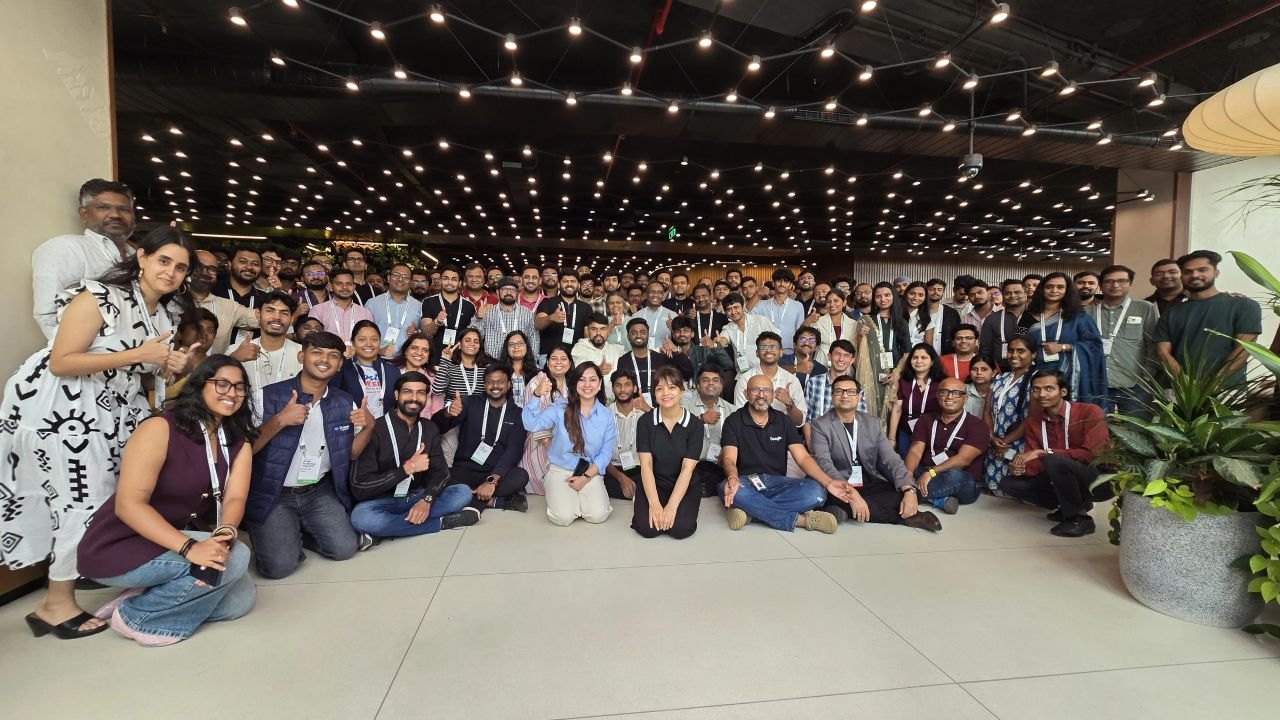
I spent a day at Google AI Day for Startups, hosted at Google Ananta in Bengaluru. We were fortunate to be invited, and for us the invitation meant a little more than simply getting a seat at an interesting event.
Over the last year we have had the chance to work with companies across logistics, energy and D2C, and to see up close what happens when AI is pointed at their growth rather than at their inbox. Some of it has been startling. Most of it has been hard-won. That is the lens I walked in with, and it made a lot of the conversations at Google land differently than they would have a year ago.
A few things I came away thinking about. I believe they are useful for any company trying to get AI into its actual workflow, not only into its slide deck.
Everyone is thinking about cost
It came up in the keynote, on the panel, and in every corridor conversation I had. Not whether the models are good enough. What it costs to run them at the volume a real business generates, every day, for good. The founders who had already shipped something were the ones asking the sharpest questions, about tokens, about caching, about where a smaller model is enough.
We feel this directly. A worker like Vikram reads a company properly before it writes to anyone, and reading is not free. The discipline we have had to build is deciding when a job needs the strongest model and when it does not, so that a customer's bill tracks the value of the work and not the curiosity of the engineer. I suspect most of the room will spend the next year learning the same lesson, and it is a good lesson to learn early.
Agentic security is not optional
The session that stayed with me was the deep dive into Google's own agent stack. One slide laid the whole platform out in four rows: build, scale, govern, optimise. What struck me is that the govern row was as long as the build row. Agent identity. An agent registry. Policy. A gateway. Anomaly detection. Something they call Model Armor.
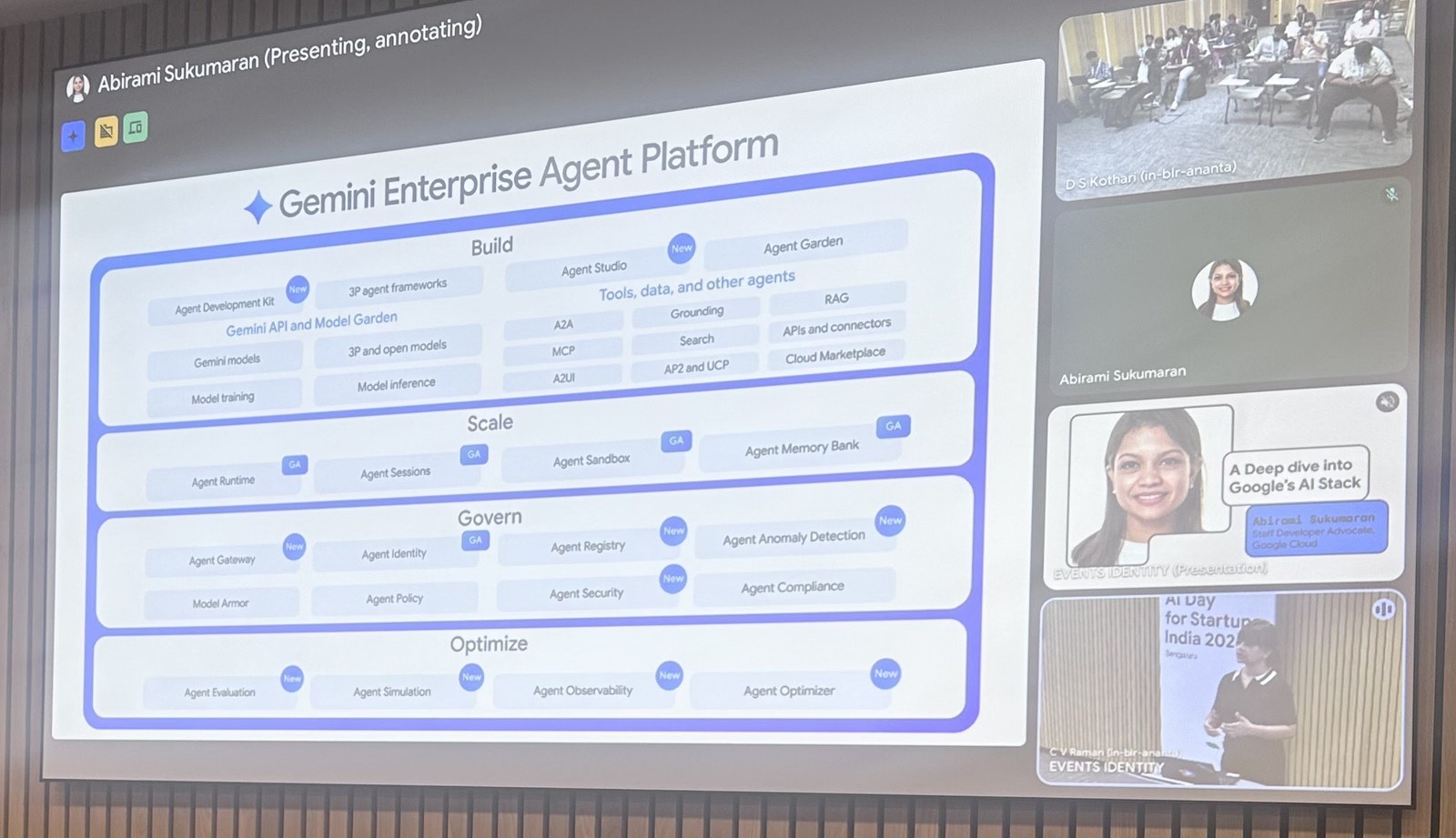
That is the tell. Once an agent stops answering questions and starts taking actions, the question is no longer what it can do but what it is allowed to touch, and who signs off. We built Evvolv so that nothing leaves a customer's business without a human yes, and I have occasionally wondered whether that made us slower than we needed to be. Watching the largest company in the room build an entire layer for the same problem was reassuring, and a little sobering. This is not a feature. It is a condition of being allowed to do the work at all.
Possibility is not the hard part anymore
Two years ago every event like this was a demonstration of what might be possible. This one was not. The best conversations were about what actually ships: which workflow, with which data, owned by whom, and what happens on the day it gets something wrong. The panel on the multi-stack advantage was really a panel about plumbing, and nobody in the room seemed to mind.
I find that encouraging. The companies we work with do not need convincing that AI can write an email or read an invoice. They need it done inside their systems, on their real data, with their name on it, and they need to know where it stops. That is a practical problem, and practical problems get solved.
A solo founder has never had more leverage
Some of the most interesting people I met were building alone, or nearly alone. A founder with the right stack can now research a market, build a presence in it and run outreach that would have needed a small team not long ago. The ceiling on what one person can attempt has moved, and the people in that room knew it. You could feel it in how they described their plans: not what they would do once they hired, but what they were doing this week.
But leverage is not the same as a sale
Here is the gap I kept noticing. Access to AI has become cheap and close to universal. Turning it into revenue has not. Knowing which accounts to go after. Writing to them in a way that gets a reply. Following up on the day the follow-up is due, not the week after. Keeping the brand visible in a market you entered last month. That is still work, and it still does not get done on its own, however good the model underneath is.
It is exactly the gap a worker like Vikram or Maya is built for. Not a smarter chat window, but a named colleague who owns that part of the job end to end and brings you the decisions. I walked into Ananta fairly sure of that. I walked out more sure.
Being in that room reminded me why we are building Evvolv the way we are. AI that does not just exist inside a business but works inside it, with a name, a boundary and a report at the end of the week.
If any of the five above sounds like where your company is right now, I would like to show you what an AI worker does with your work rather than with a demo dataset. Write to me, or find me on LinkedIn. I post more from days like this there.
Harshit Gupta
Co-founder, evvolv.ai